Define the exact outcome the formulation team needs before discussing production.
Custom extract sourcing
Custom Botanical Extract Manufacturing and Sourcing Support
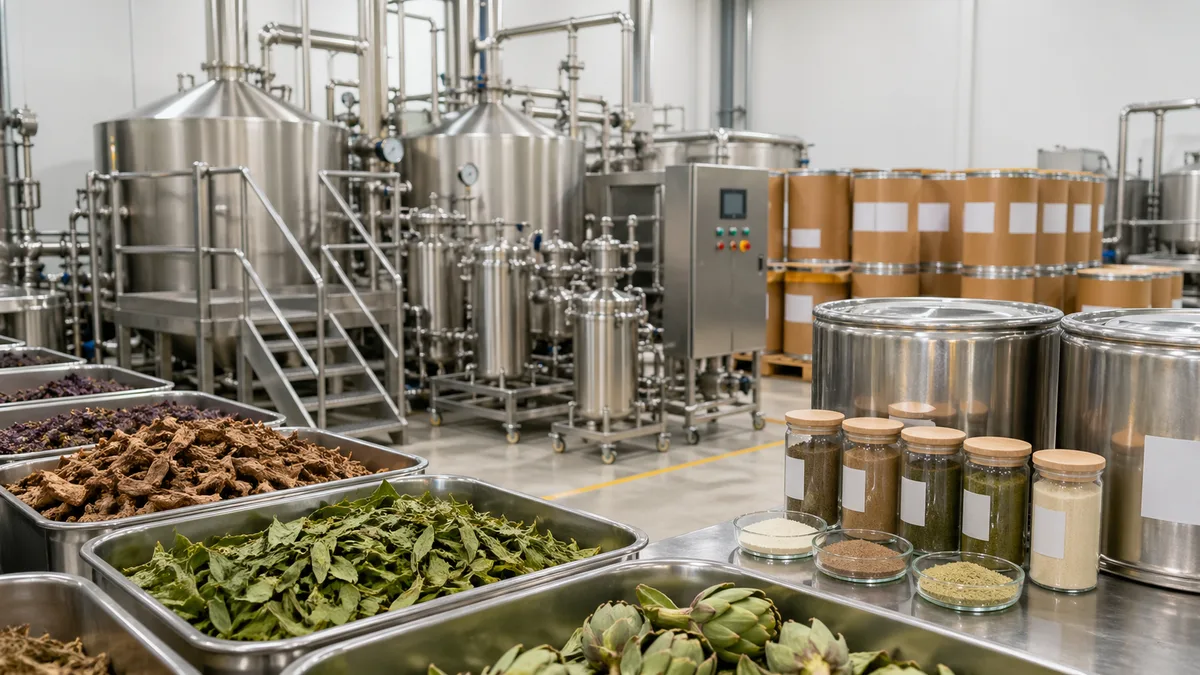
For buyers who need a custom marker level, extraction ratio, particle size, solubility target, or made-to-order botanical ingredient, Essence Source helps structure the technical and commercial review.
When custom sourcing makes sense
- The required active marker differs from available standard grades.
- The application needs a specific solubility, color, taste, or particle size profile.
- The buyer needs an extract ratio, plant part, or test method not listed in the catalog.
- The project volume supports custom production, testing, and lead time planning.
Useful starting points
Custom review decision table
| Start with a standard grade | Use this path when an existing marker, ratio, COA/TDS path, and sample route meet the formulation and launch timeline. |
|---|---|
| Modify a grade | Use this path when the buyer needs a different carrier, particle size, solubility target, sensory profile, or packing requirement. |
| Request custom production | Use this path when the marker level, plant part, process, method, or commercial specification cannot be met by catalog grades. |
| Pause the custom request | Pause when target volume, approval criteria, application, document needs, or timeline are not clear enough for production review. |
What custom extract review actually requires
Custom botanical extract sourcing should begin with a technical brief, not only a product name. A buyer may need a different active marker level, extraction ratio, plant part, carrier, solubility profile, particle size, taste profile, color target, or contaminant limit. Each variable can affect feasibility, sample timing, MOQ, test method, and commercial price.
Clarify how the buyer will judge color, taste, solubility, assay, and handling.
Custom paths need enough volume and timing flexibility to justify production review.
Custom specification checklist
- Botanical source, plant part, extraction ratio, and target active marker or assay range.
- Preferred test method, internal QA limits, and any third-party testing file expectations.
- Target application, dosage form, sensory constraints, solubility need, mesh size, and carrier preference.
- Sample quantity, approval criteria, project timeline, and expected commercial volume.
- Packaging, destination, and whether a U.S. stock or replenishment path is needed after approval.
Custom path versus standard grade
Not every project needs custom manufacturing. If a standard grade already fits the formulation and label goal, it is often faster to request COA/TDS, sample review, and RFQ on that standard product. Custom review makes more sense when the target marker, solubility, particle size, application, or commercial positioning cannot be met by an existing grade.
The listed specification fits, sample timing is urgent, and the buyer wants a simpler RFQ path.
The project needs a different marker, process, format, or approval target than catalog grades provide.
How to start a custom review
Send the technical target, application, expected volume, sample criteria, and document needs first. The sourcing desk can then help determine whether the request should move through a standard product, modified grade, or made-to-order production path.
Questions to answer before requesting custom production
Custom extract work is strongest when the buyer can describe the target result and the business reason behind it. A higher marker, different solvent path, tighter particle size, or improved solubility may be possible, but each change can affect cost, sample timing, document review, and repeat supply. The first conversation should separate must-have requirements from nice-to-have preferences.
- Which requirement cannot be met by an existing standard grade?
- Which result will decide sample approval?
- What first commercial volume supports the custom path?
- Which documents or testing files must be reviewed before approval?